Tuesday, September 24, 2013

St. Petersburg – First Impressions


We arrived in St. Petersburg at about 8:45am, and through minimal language, found a taxi driver, who was very nice, drove us in a roundabout way to our hotel and charged us almost double of what it should have cost.  Oh well.

Ricky on the Balcony
The hotel that Chris booked is lovely – small European-style (why not, we’re in Europe now!) boutique hotel at a great location on a canal (I had no idea St. Petersburg had so many canals!) and near the main drag, Nevsky Prospekt.  We had to wait a few hours before a room was ready, so we grabbed a quick bite in the downstairs café and headed out, like tourists, with maps in hand, to get a lay of the land.

We're at 60 degrees North latitude - the highest we will get on land for this trip.
 St. Petersburg shares this latitude with just a few other cities; Anchorage, Oslo. But it is the population king at 5 million people living in this inhospitable climate with just 60 days of sunshine each year. Cold temperatures and a cold, wet wind that blows and blows.

Yet, we are blown away by this city.  Because Peter the Great wanted his capital to compete with the cities of Europe, he hired European architects to design and build the city from the ground up.  As

a result, with a string of canals running throughout, St.
Another "Cathedral of the
Spilt Blood"
Petersburg looks like a cross between Paris and Venice, dotted with minareted (is that a
word?) Russian Orthodox churches.  Many road and pedestrian bridges arch gracefully over the canals, reminiscent of the ponts over the Seine.  It seems that beyond every corner we turn, there is some incredible-looking edifice that was someone’s palace or private art museum.

We returned to the hotel and checked into our room… For a relatively small amount, we decided to upgrade, to give ourselves a break after our cramped train compartment.  They didn’t have a room up one level, so they jumped to two levels for the same price.  Frankly, the room we got has probably not been totally updated (although it has a great bathroom).  However, the 3
The Mother Ship
rooms we are staying in are collectively larger than our condo in Breck.  Easily.  The main room has a very elegant dining table that seats 10, an elaborate inlaid parquet floor (Chris likes to slide across it in his slippers), grand piano, gothic Adams-family-esque couch, with chairs, where even Chris could comfortably sleep, a porcelain tea set, and a gargantuan chandelier descending from the ceiling like the mother ship at the end of Close Encounters of the Third Kind.  There is gilt molding on the doors, walls and ceiling that are reminiscent (I’m not kidding) of the Grand Staircase in the Hermitage, and we have the only balcony in the hotel - it overlooks a canal and park.  Note:  the Hermitage is the winter palace complex built by Peter the Great in the 1700s. The Grand Staircase is the one section built in the Rococco style – gold on white, very ornate – THAT’s what our room looks like.  The bedroom is much more understated in its décor – thank God.

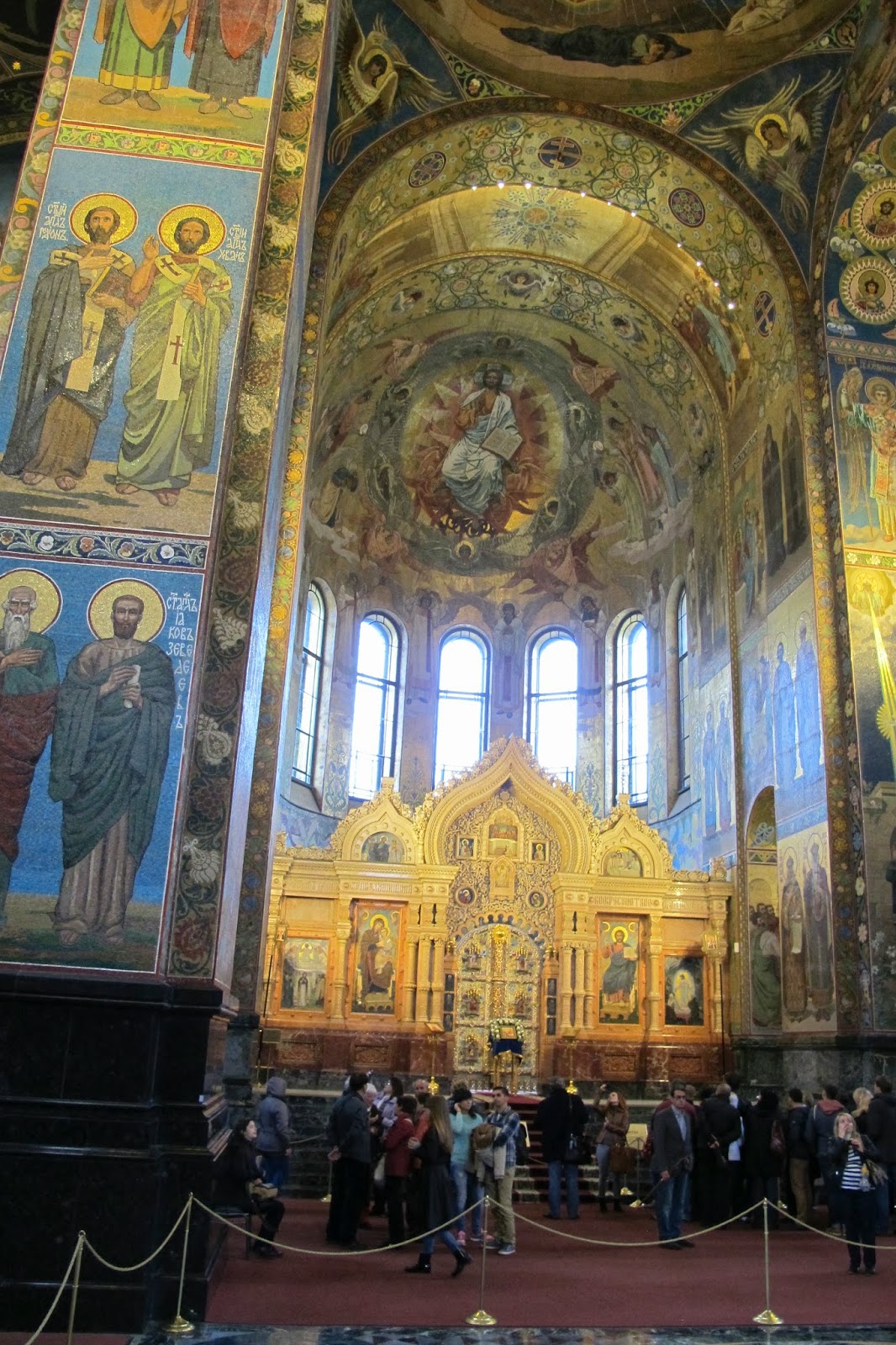
The main alter in the Cathedral
After checking in, we ventured out again in the pursuit of food.  On the way, we visited an awesome church called Cathedral of the Spilt Blood which was built on the spot where Czar Alexander I was mortally wounded - the friggen EIGHTH attempt on his life!  Incredibly imposing structure with large multi-colored minarets and an interior that was pretty much marble on the floor and columns and mosaic of religious icons that was so detailed, it looked like painting.  Mosaics - because the tiles are heartier at the 60 degrees North climate than canvas. 

We wandered some more and found a wonderful Georgian restaurant.  Chris has a knack
Caucasian Food
for finding great, out of the way places on the fly, and this was no exception.  The folks there were very friendly to the drenched foreigners coming in out of the rain.  White table clothes, cozy atmosphere, and great food.  The Georgians make a walnut paste and stuff things with it or shape it into patties for appetizers, and then they do wonderful things with beans and cabbage and a unique blend of spices – I think one is fenugreek.  Chris had a delicious meat dish with an amazing tomato sauce (I had a taste without the meat.).  With a couple glasses of red wine, it hit the spot.  Great day.

Monday, September 23, 2013

Yekaterinburg - walking through the city


Dawn in Yekatrinburg
the Cathedral of the Blood in the center
We took off for a few-hour city hike of Yekaterinburg - a city known as the place the last Czar and his family were murdered, but one with a far richer past as an early selection for the Great Soviet Industrialization.  It was actually closed to all foreigners until 1991.

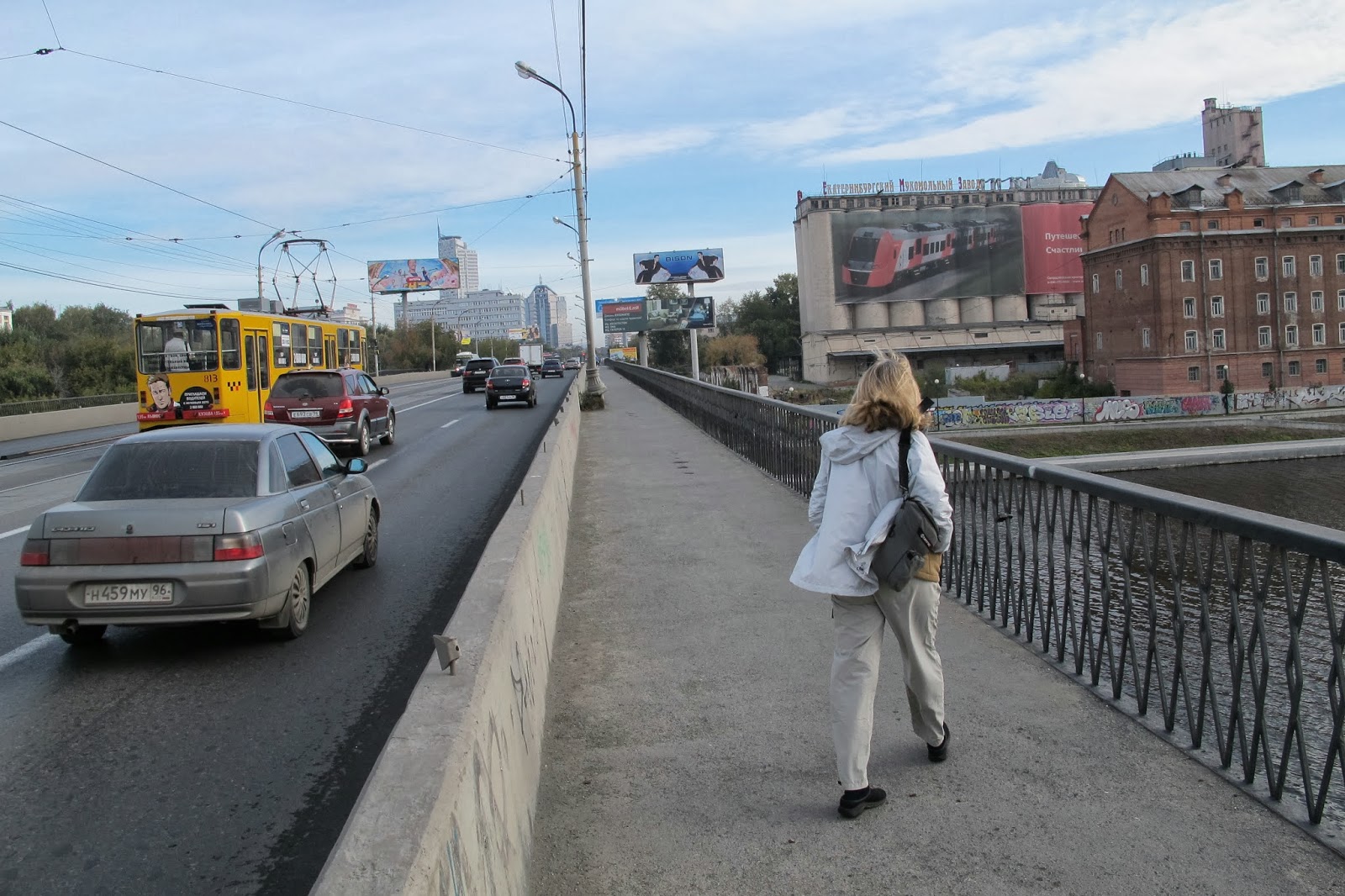
We walked north over a wide transit and vehicular bridge leaving the new government and industrial center and over to the older cultural and religious center.  Ekaterinburg is a young city with young couples, young singles and young families everywhere, dotted with the occasional lumbering old large woman in a babushka and older men leaning on railings at bus stops smoking.

Cathedral of the (Spilt) Blood
We navigated down first to Voznesenski Cathedral – one dismissed by the guide book but rich in history and active in use by the locals.  The murals inside had been painted over during the soviet religious purges in the 1930’s but some have been recreated and restored.  These Russian Orthodox churches are different than European Catholic churches; no altar really, and more the feeling of a Buddhist temple with icons all around and prayers said at different stations.

Over to Cathedral on the Blood (many called it “Cathedral of the Spilt Blood”) and first to the Romanov memorial; allegedly on the site where the Romanov family was killed.  The memorial is inside a building that contains the Chapel of St. Nicholas and displays icons of the Romanovs everywhere as sacred martyrs.  We bought some local items… looked at photographs and even a film of the Romanovs.

It’s Saturday, and the main Cathedral on the Blood chapel is on the wedding tour. The bride and groom
On the Wedding Photo Tour
travel with a small entourage of family and friends and have their picture taken at key city locations.   Inside the cathedral there are  icons and Romanov photographs. We walked into an impromptu staged production with dramatic readings and singing.  Ave Maria…  the singers were getting up in years and their voices were beginning to show the signs.  Today, though, they sounded beautiful.

The Mill Owners Mansion
We wandered out to a dammed portion of the Iset River.  All Russian river towns have dammed rivers just upstream of a 19th century water powered mill; timber, steel, ore processing, etc. The mill owner usually had an elegant house on the dammed lake and gave generously to the local cathedral which was also nearby.  There are thousands of river mill towns across 18th and 19th century Russia; a single spectacular mansion, a single mill complex, a single spectacular cathedral, and the workers settlements.  Today on the dammed Islet, a sailing regatta was underway.  Times change.
Regatta on the Islet River

We walked down the street to some impressive city administrative buildings in search of the money changers!  Something we've been doing on these stops between train segments.  We were lucky to find an open bank changer on a Saturday.  She spent lots of time looking at my passport, remarking on the places I had been “India!  India!” and scolded me a little for not knowing any Russian.

OK...just a nice picture
We then met up with Konstantin Brylyakov, local and  English speaker and owner of Yekaterinburg Guides.
Tall, lean, late forties, fast-talking, green orientation, had his script of how things should be, fast walker, born and raised in Yekaterinburg… knew his stuff and loved his city.

We were driving in some sort of Japanese wagon that he had equipped with two tanks; one petrol and one CNG.  He is proud of it and this city is proud of favorite son Boris Yeltsin, proud of the past accomplishments of being a city designated for the great Soviet industrialization of the 1930s (and closed to all foreigners until 1991), proud of the Russian tanks manufactured here that were instrumental in the German defeat in World War II, proud of having the best universities, the best airport, the best growth plan, the best mix of people, the best, the best, the best of all of Russia! Konstantin described the earliest colonial architectures when Russian Cossacks came over the Urals to colonize the Tartars (Mongols), mixing agriculture with herding.  Next, the beginning of the 18th century small houses with their ornate window jambs and shutters, the industrialization phase of the 19th century – he sees the old abandoned brick mills now as historically charming and nostalgic, this included these ornate mansions of the rich industrialists and the cathedrals they sponsored. The revolutionary style (Soviet) that lead quickly led to the neo-Stalinist and “constructivist” architectures that were purpose-built to most effectively progress needs of the state as given from top down direction.  Ricky’s recollection:  Soviet style called “constructivism”; Stalinist architecture called Neo-classic.

A great time in a very attractive city -- but we were ready to get outta Dodge and walk in the Ural Mountains!


Yekaterinburg - into the Ural Mountains


the Dacha Community
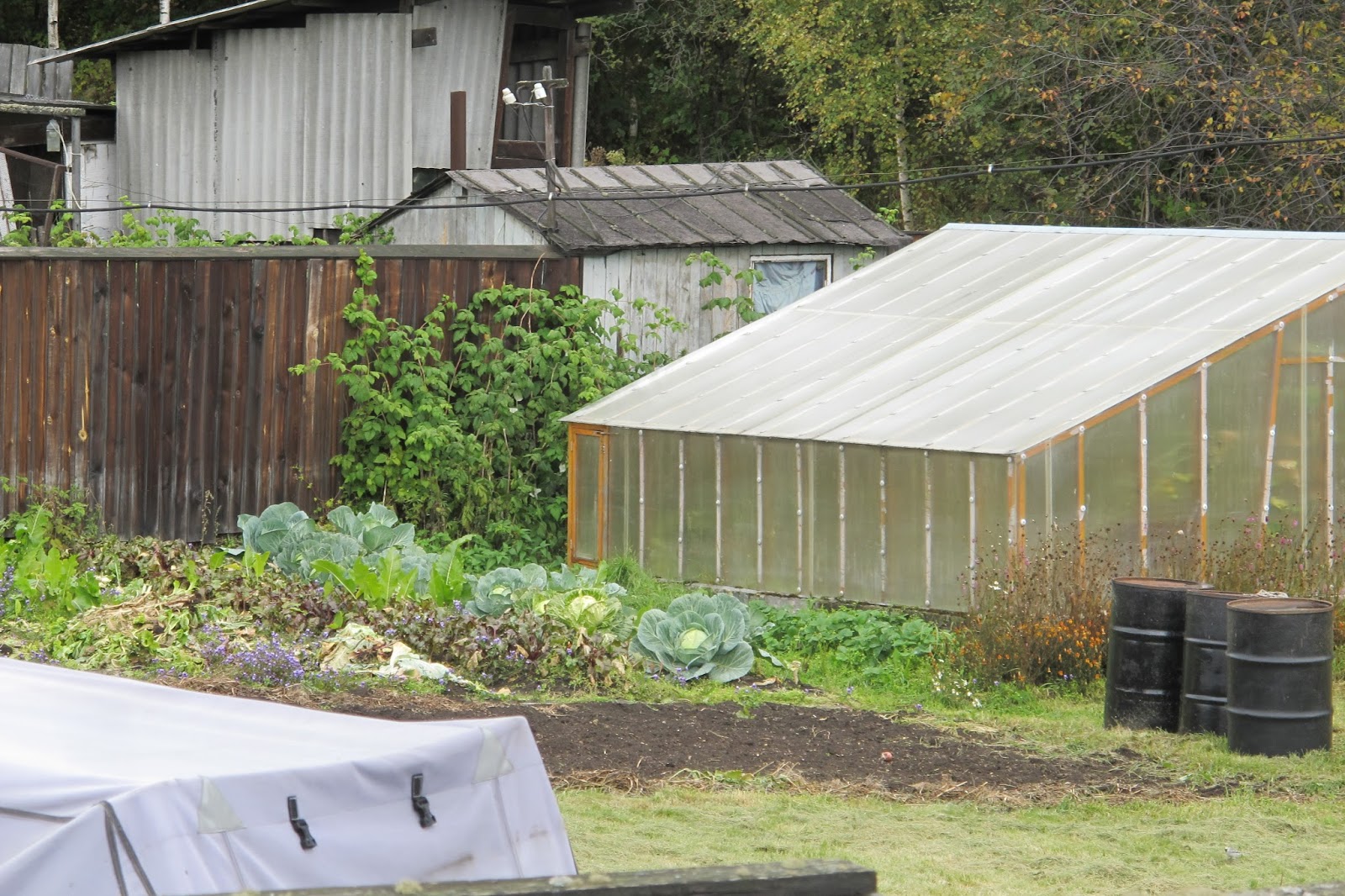
The ride out of town gave us a good look at the dachas, in dense communities of old small cottages where city apartment dwellers flocked on weekends to connect with their agrarian past.  “Everyone is growing something and what they can’t use themselves, they sell” - Konstantin.  We saw selling on the highway too – glass jars for canning, twigs for medicinal tea, canned stuff, extra potatoes, mushrooms and berries and larger farmers goods too with fall harvests – beets, pumpkins, vegetables and fruits in bigger quantities. 

Examples of the great woodwork
in the log architecture.  this from
the city
A stop at an old traditional wooden church – this for St. Alexis – the youngest and the heir to the Romanov chain. The religious purge that destroyed thousands of temples in Mongolia in the 1930s occurred in Russia too – religion seen as a useless and silly artifact of the past and a threat to putting all beliefs behind state goals.  Few of the old churches remained.  Beginning with Glasnost under Mikael Gorbachev religious tolerance returned but Russia is now only 15%-18% religious beliefs.  Most are agnostics.  We were impressed by the Russian Orthodox minarets and filigree combined with the log architecture. The dacha house is a pretty simple affair - except for the elaborate carving on the wooden window frames.  Stunning!


Picking Berries
The Trailhead
Up to a little village that was the birthplace of Russia’s beloved children’s’ storyteller and novelist: (we’ll get his name later) More lovely dachas and great to see Russians enjoying a Saturday. We hit the trailhead for a five-mile hike into the Urals – they are low in elevation at this point but still very rewarding with lots of Siberian pines (tall, straight as an arrow lodge pole pine-like with needled branches only at the top of the canopy. We looked at massive beaver dams and picked up trash along the way “from the children”.

The Old Quarry
We did some wild berry harvesting, a Russian-only berry that grows on a bush but tastes like a cranberry; indeed later on the next train segment we saw plenty of people selling buckets of these berries on the platforms.  We investigated the old soapstone and talc quarry now filled with groundwater, lunched late at a great spot filled with locals
Reflecting the Aspens, Birch and Siberian Pine
simply enjoying themselves, the last warmth (54F) of summer with their families and their dogs.  Lots of women line dancing, men and boys with soccer balls, picnics, laughing, a few dogs playing and camaraderie under the tall pines and the aspens with family and friends.  The park ranger came up as he does with some guests and groups, was smiling and gracious in Russian, bid us “Dosvydania” and went to the next group (who shared their napkins with us).  We needed this – although packed with people – it was a great hike, got the heart pumping with some modest climbs, but most importantly filled me with warmth about the Russians that I thought was not there.  Nowhere to be seen were the “Icy Ivans” that are so generalized everywhere.  Just warm, happy, engaging people who love their families.  No pictures of this - these families were not a tourist attraction.

A beeline back after extending a hand to a very nervous mother who lost two young teenage boys by giving her a ride to local authorities (the boys were found while we were enroute. The mother was left on the roadside crying happily as her party came to pick her up.  We’ve seem mothers like this behave everywhere).

Back in the city we asked Konstantin to drop us at a local market so we could buy some train fare beyond just the noodles and dehydrated potatoes that were a staple on our last train leg.  He took us to a massive new retail center with a huge supermarket.  We bought pickled salads, vegetable dishes, cheese, crackers, Swiss chocolate and …. Russian Standard Vodka.  Quite a haul.

We paid for a full night at the Hyatt even though we were not staying there just to have access to a shower, the internet, packing area, laundry, the Hyatt Regency club…  pricey, but worth it.  We enjoyed a light snack and dessert for a temporary anniversary dinner with a few glasses of Prosecca, checked out, Jaguared back to the train station, lumbered to our platform, role-reversed, and settled into our best berth yet for the 36-hour train journey to St. Petersburg.   

Friday, September 20, 2013

Camping out on a long train

The Food Routine

Today (9/19) is the first uninterrupted day of travel on the Trans-Siberian Railway (actually, it will be about 3 days on this leg), in terms of sleeping on the train the night before, experiencing a day without border delays, and looking forward to a second night on board.  The train departed Irkutsk the evening of September 18 at about 6:30pm.  After lugging our bags and a large sack of groceries through the station, up and down stairs (these stations don’t have escalators, unfortunately), we joyfully found our compartment and settled in, after receiving fresh sheets, pillow cases and towels from the porter (the provodnista).  In our second-class
Bubba Blending on the
Platform during a stop
compartment, there are 4 berths, so our routine has been to sleep in the upper bunks and lounge on the lower bunks, sitting mostly at the small table by the window for eating, reading, writing, lounging, etc.  
This train has no dining car, so we had to scour the markets around the Irkutsk train station for 3 dinners and 2 lunches-worth of food that could be prepared by adding hot water from the train carriage’s samovar.  We learned that the best bet for a hot meal on board is an Asian version of Cup O’ Noodles - same kind of packaging, but with Chinese, Mongolian or Russian text on the outside.  Most of the time,
Restocking after unknowingly buying
 too many dehydrated potato 'meals"
we’ve had to trust the pictures on the Styrofoam bowl, and once or twice, we ended up with mashed potatoes instead of noodles, or meat instead of veggies.  (I’ve had to relax my dietary guidelines as a result.)  So breakfast has been essentially a Cliff Bar (I brought a bag from the US), dried fruit and
after a food run
tea; lunch today was a bowl of ramen noodles each, and half a candy bar.  We’ll have salted peanuts for cocktail hour with some good Russian vodka, and dinner will be another noodle bowl or a meat thing for Chris and mashed potatoes for me.  I shudder to think of the chemicals and preservatives we’re consuming, but there isn’t a better solution for a hot meal.  The last leg from Yekaterinburg to St. Petersburg, we think, we’ll have a dining car and tomorrow night we’re in a Hyatt in Yekaterinburg, so we’ll have a good meal (and a shower!).  In the meantime, we are enjoying the time camping out in our compartment, watching Siberia go by.

Transversing Siberia

Irkutsk Railway Station

The section of the Trans-Siberian Railway across Siberia from Irkutsk, in central Siberia, to Yekaterinburg, just west of the Siberian border took 55 hours and covered about 3400 kilometers (2200 miles) and dozens of stops in towns and cities big and small. Our carriage originated an additional 2200 miles to the east in Blagoveshchenk, a remote Chinese
Hanging in the cabin
border town and our window shows the length of the journey with the dirt on it. We’ve been in or just outside our cozy Cabin VI on Carriage 3 that entire time and have had lots of time with our faces staring out the window.  Rather than seeing wasted plains that we expected, we’ve observed a rich landscape dominated by rolling hills in the east and extended steppes in the west with the brilliant fall colors of aspens and birch for the entire duration.  We’ve seen small towns with small houses and gardens growing some of the biggest vegetables in the richest of blackest soil. We’ve seen rivers running from the
Crossing the Tomsk River
north still carrying a lot of water. We’ve seen railway towns, many apparently in existence when the railway was first being built in 1895 and during the century before it as a waystation on the Siberian Post Road that have gone from boom to bust as the increasing speed of the engines have left them behind for the larger communities. We’ve seen buildings that may have begun with the Tsars, continued into the early days of the Revolution, and then into the Stalinist and Soviet days through today’s Russian republic. They might have been in favor for one of two of those eras, but not for all.  We’ve seen plenty of train
Surface Coal Mining
lasting a few Russian Eras
stations that exhibit structures with fresh coats of bright turquoise or salmon pastels and at the same time, include an ominous-looking windowless brick turret tower, probably abandoned when radio and electronic communication replaced the sentries positioned there.  We’ve observed train travelers being sent off by their teary-eyed relatives, hawkers selling homemade food and packaged concoctions from the platforms, and train workers with long metal mallets mysteriously banging at things on our train’s undercarriage while in the station.  We’ve seen our carriage mates in the other eight cabins on Carriage 3 change frequently; from workers moving around the Siberian coal fields, to businessmen on mobile phones to young families.  And unlike the previous two segments on the Trans- Mongolian railway, we have seen no Americans and only one other English speaker.       

We experienced thick low grey clouds and spotty sprinkles of autumn as we started in Irkutsk. And, oddly, just as we passed the area where we were “officially” out of Siberia, the clouds broke and we were treated to a gorgeous sunset over the plains. Just in time for our anniversary!

Tuesday, September 17, 2013

the Long Way home

Hey, Folks!  I tried to insert a map way back when we started the trip, and it didn't seem to show up.  This is a smaller file, so hopefully it will work.   This map depicts our journey from Singapore to Stockholm and off the map to the US.  We are a bit more than half-way home!

Lake Baikal – 50 miles wide, 400 miles long and a mile deep!


The Aspens are turning in Siberia!
Irkutsk was our first railroad stop in Russia, and we had the good sense to book a hotel in Listvyanka, a small picturesque village on Lake Baikal, where the lake’s water flows out the Angara River, the only outbound river on the lake.  The rainy, moody day of our arrival broke to overcast with grey humid clouds hanging in the valleys with spots of blue sky.  In the distance, we could see the snow-capped peaks of the Khamar-Daban Mountains on the southwest side of the lake.  A long, long ridge.  And this wasn’t new snow from the rains, but snow that keeps winter to winter.  
Monster Cabbage in Nicola
We hiked to the village center we saw in the distance up the river – only to discover that I (chris) was wrong.  This muddy dismal port town was Nicola.  Nonetheless, there were a few homes with fresh blue-painted shutters and windows filled from inside with flowering geraniums.  And this place of extreme temperatures knows how to garden too.  Nicola, the less-favored of the ‘charming villages’ on the lake is home to some monster cabbage plants and nearly everyone has a greenhouse to extend the growing season.  We found a tour bus leaving a restaurant (our new technique for restaurant   Our evening brought continued clearing and a brilliant sunset that made the most of the remaining clouds.  We enjoyed the show with some more local vodka (another new favored technique).
across the Angara as it enters the Lake
recommendations with some possibility of English usage) and had our first taste of Omul, a fish native only to the lake. It turns out that there are lots of animals native only to this lake including the fresh water snow seal – hunted ferociously for centuries but now protected.
The next day, we walked the opposite direction from the hotel down the main road, and found the village center we had been looking for.  Listvyanka turned out to be small, quaint, yet bustling with activity along the waterfront.  Travelers wandered up and down the main street and waited on the docks for the ferries going back and forth, between Listvyanka and ports miles away on the Lake.  We sat on a bench and had an impromptu chat with an Australian squeeze-box-playing tourist looking for a ferry with his Chinese friend. 
School's Out!  Boys in searsucker suits
(no relation to the snow seals)
We bypassed the souvenir vendors and found a highly-recommended café – Proshily’s Café – or at least we think we found it – all signs are in the Russian Cyrillic alphabet here. 
Proshily's Cafe!  (we think)
Had a delicious meal, anyway – two different kinds of local fish, Omul and Sig, a white fish, and vegetables, both grilled to perfection. Our hiking continued up to a ski area.  One (really slow) lift, five runs, a base area that reminded me of Geneva Basin in the late 70’s (except not as nice). 
an old worn out ski area
We pondered if they had a Guest Services squad and if there could possibly be any colder ski area where the average here in the winter in -25F.  In the evening, we enjoyed another spectacular sunset show over the lake.  This was a nice introduction to Siberia, in spite of the dourness of the locals (“Icy Ivans” as they are called).  Do they know something we don’ know? We keep doing drive-bys of the news to see the status of Syria to determine if our Yank passports are the problem.  Anyway, a lovely town, excellent food, gorgeous, big beautiful, epic lake surrounded by snow-capped peaks and glaciers.  What could be better?