Sunday, September 15, 2013

Ulan Bator to Irkutsk on the Trans Mongolian railway

Our abandoned carriage
and some happy dogs
at Suhbaatar, Mongolia

“Miles and Miles of Miles and Miles”, “ Actually, I got kinda bored”, “Nothing and Nothing and Nothing”.  These are some quotes out of TripAdvisor on the Trans Siberian and Trans Mongolian lines.  Ricky and I are on our second rail leg of the trip and the last on the Trans Mongolian route; one that follows the path of the tea caravans from Peking to Europe in the 14th Century. Just over a 1,000 slow-moving miles over three days and two nights from the capital of Mongolia to what has been called the “Paris of Eastern Siberia”, Irkutsk, in the Russian Republic.  (I suppose you could call Commerce City, CO, the “Paris of the Northeast Denver Metro Area and get away with it too.)   

Sure, those emotions of vastness and loneliness may arise, but not quite yet.  We just can’t stop looking out the windows – the scenery is so varied and at times, stunning. 

Using the delay to find some fine
Russian vodka at Naushki, the
Russian border post.
Boarding the train in Ulan Bator late the evening of the 14th was a trip in itself.  The old and gritty station was packed with travelers of all shapes and sizes, the garbled announcements were in Mongolian only, just one tiny convenience store was open, and we had no clue where to pick up our train.  After some exploration, Chris finally learned our track from a hassled ticket agent in a different building from the waiting area.  In broken English, she repeatedly warned Chris to stay close to our gear, as people like us were sitting ducks for thieves.    And, indeed, as we moved toward our train, a shifty-looking guy carrying a plastic shopping bag followed us from the waiting room, and then pivoted and disappeared as soon as we walked toward a policeman. 
The Tail End of the Russian
Special Customs Agent
After boarding, we fell asleep in our compartment to the vibrations of the moving train and awoke in a Mongolian border town, stopped.  Since we were at a station, the train's WC couldn't be used, so I wandered off the train to find one.  Looking back, I saw that our car was standing alone on the track - the back end of the train was pulling away, and there was no engine.  We were told to expect this, that the Mongolian engine would take off, and a Russian locomotive would take its place.  So, after several hours, including a Mongolian customs process, we pulled away.  Then it seems the process was repeated again in a Russian border town.  The entire engine-change-immigration-inspection-customs process took about seven hours, including two separate instances where our compartments and luggage were sniffed by dogs. At least we were allowed, most of the time, to get out and look around while this was going on.

Gusinoye Ozero (Goose Lake)
along the Selenga River
Today, we’re following the Selenga River for most of this leg.  A huge river about the size of the Missouri River at Omaha, with its headwaters in Mongolia, its normal peak flows are this time of year. The Selenga runs into Lake Baikal, the largest freshwater lake in the world and our next destination.  The rivers that drain into this lake are among the small handful in the world that don’t empty into a sea.  Along the way there are natural lakes, some big and some huge, with deep blue water, surrounded by autumn colors dominated by a golden wheat against a huge blue sky. 

This is also the land of the Buryat civilization of a long time ago and the blue of the water must hold some
Blue and white everywhere even  in this old beat up coal town Zagustay
significance for that culture or for the current locals.  Lampposts, manhole covers, the bottom of power poles are all freshly painted in the lake blue bordered by white.  The roughest looking house will have the freshest blue paint on the door.  We see that blue at all the stops along the way, along with a good collection of dogs, some young adults using the arriving trains as the center of the towns’ social life, and some scenes unique to the Russian frontier – old women harvesting their back yard gardens, older men at construction sites grabbing some discarded material maybe to help get through the harsh “continental” winter to come.  (Funny use of that word.  A “continental” breakfast is light and easy; a “continental” weather pattern is apparently harsh and unforgiving.)

And we listen to the sounds of the journey.  At first, we thought we heard a string and reed orchestra as we pulled into a small town siding.  Turns out these eerily-resonating harmonies were caused as the steel wheels
This berth built for four!
Not this time
strained against one set of tracks and rolled onto the next. The sound of dead quiet as the train then begins to move again.  The European-style train whistles, the sounds of the other passengers passing time with travel stories in a half dozen languages.  The sounds of the Russian carriage steward yelling at Ricky for rinsing her noodles down the samovar drain, and at me for splashing water onto the floor from the samovar, and then hearing the sweetest tones when she stopped to sell us some of her train treats.  

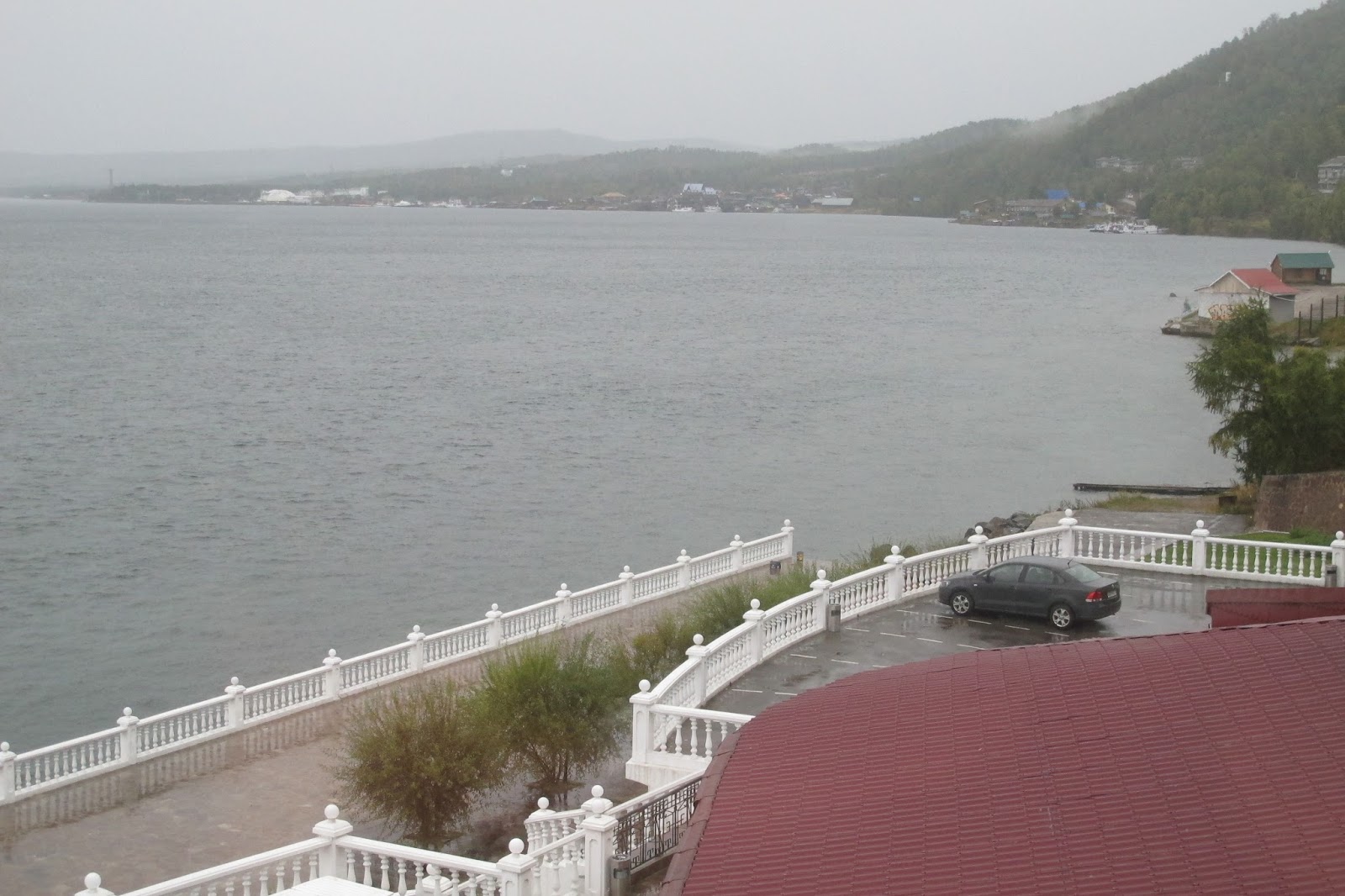
Now, a rainy, moody day in Listvyanka, on the shores of Baikal. Hope it clears soon.  It looks like fresh snow on the mountains to the north!

Friday, September 13, 2013

Three unforgettable days in the Gobi

The Sea of Grass

The morning of September 9, we headed to the Southern part of the Gobi, via unsigned dirt track, where the dramatic landscape gradually evolved from green steppe to golden steppe to an area punctuated by rocky sand dunes, if that makes sense. 

We saw our first free-grazing herd of Bactrian camels (two humps), gentle bizarre-looking critters, curious of us as we were of them, and enjoyed our first view of the Southern end of the Altai Mountains.  
A constant sight
They reminded us of a rugged version of the Sangre de Christos – dark grey, brooding mountains with gold, dry grasses in the foreground.

From the deck of the Lodge 
By lunch time, we arrived at Three Camel Lodge, where we stayed 3 nights.  It is a gorgeous ger camp, with the main buildings beautifully built with native stone, wood beams and Mongolian-style molded roofing.  Our "deluxe ger", on the edge of the camp, had a smaller ger attached with a stone-tiled bathroom; and sitting out front on the stone base of the ger, we had an unobstructed view of the Gobi and the Altais.

Our first morning at the lodge was relaxed – nothing planned except to enjoy our beautiful surroundings.  Herds of horses and goats were taking turns at the nearby water trough, so we wandered out a ways in front of the lodge to hang out with them and their dogs, and a few herders, one on foot, another in traditional garb on a horse, and a third, the goat herder, on a motorbike. 
This was one of the experiences we craved; just wandering the desert with hardly anyone around, hearing nothing except the wind and the animals braying and drinking.
After heading back that afternoon, we settled on a double swing on the sunny side of the lodge’s covered porch and ordered a bottle of Mouton Cadet white Bordeaux (a start to Ricky's Birthday!).  It was a wonderful moment – late afternoon on the swing, looking out into the Gobi with a glass of cold French white wine – OK, maybe a bit over-the-top, but what the heck.  We finished the bottle (much later!) over a dinner of lightly fried fish and vegetables – delicious.
The next day, we drove to an outcropping of sand dunes, where it was very tempting to slide down on ….something.  Looked around for a saucer or cafeteria tray or Flexible Flyer, but there weren’t any.  Beautiful white sand against a chunky blue sky, the image often associated with this desert.  

We climbed up on a dune, looked around and saw no one for miles and miles.  We then drove to a patch of trees that only grow in the Gobi – about the size of mesquite with succulent needles and gnarly, dry, twisted trunks and limbs.
We drove to the Flaming Cliffs, so-called because of the color they exhibit in the later part of the day.  This is where Steven Chapman Andrews, American
explorer funded by the Natural History Museum in New York, discovered a significant location of dinosaur bones that had been effectively preserved when the sand dunes collapsed about 60 million years ago.
On the 11th, we motivated early, for a trip to Yol Valley, about an hour’s drive in a different direction from the lodge.  Beautiful valley that was wide, with the colors of the Gobi, dotted with green and red plants – and as we hiked further, it evolved into a narrow rock-sided canyon.  The rock looked like a kind of shale – we will have to look at the geology of the place at some point! 
The Yol Valley
Boiah wanted to head back after a half-hour, but we kept going for a couple hours total – about 6km round-trip, according to Chris’ fancy watch.  Lovely hike.  Then, one more heavenly afternoon on the porch; the next morning, a quick trip across the desert to a local airport, and we were back to reality in UB.

The Gobi was wonderful.  Even the harshest of winds increased the silence.  Herds of camels, horses, yak, cow, sheep goats moving closely together as ships sailing on  the sea of grass. We simply cannot capture it all here.  and, a great place to celebrate Ricky's birthday!

Visiting a nomadic family


When I woke up on September 8, I never guessed I’d be milking a mare later that day…. Will get to that.
Herding on the Steppes
We headed South from the Karakhorum camp for a short while on a dirt track – we were on dirt tracks from now on – and suddenly Boldah, our driver, veered to the right onto the steppe.  We wondered – WTF?  It was a short cut to a more travelled track.  We constantly marveled that he always knew where he was going, across the vast Mongolian steppe – no signs, very few roads.  But he had been doing this for 15 years; we were not concerned.
Another right turn, and we were headed for the ger encampment of a nomadic family.  Two gers, a satellite dish, a solar panel, about 25 head of horses and some goats across the way.  The lady of the house, wearing a Boston, Massachusetts sweatshirt over a cashmere sweater, turned off the small black and white TV, powered by 3 car batteries, and welcomed us into her home.  She was busy making a number of foods from yak milk – a dried yogurt that tasted like a sweet parmesan, dried bean curd, a butter that was like a solid, but soft ghee, a very smooth vodka, and then fermented mare’s milk.  All pretty tasty. 
Then it was time to milk the mares - apparently, they do it about 5 times a day.  I tried it for a few minutes (hence the opening comment).  The teats were about 4 inches long and smooth – the technique involved starting at the top and smoothly moving downward, pinching the teat
Ricky trying her hand
between thumb and index finger.  I squeezed out a fraction of what she was able to produce.  It was lovely to hang out with the small herd of horses.  As their silent herder, wearing traditional garb, (the woman’s husband?) looked on, we took a close look at a saddle setting on the one horse who was tethered.  It was hand-carved from wood with steeply sloping front and back and it sat on a thick felt pad,
A Traditional Wooden Saddle
all tied down with hand-made leather and horse-hair straps.

We thanked them as best we could and took our leave, not before our hostess ran out with a bag of yak milk goodies.  It was a visit we won’t forget.

KharaKhorum, the ancient Mongolian capital


Our next stop was the Kharakhorum Valley, which was the location of the Mongolian capital for about 40 years, when Ogedei, son of Genghis, was Great Khan – this was about 1240 AD.
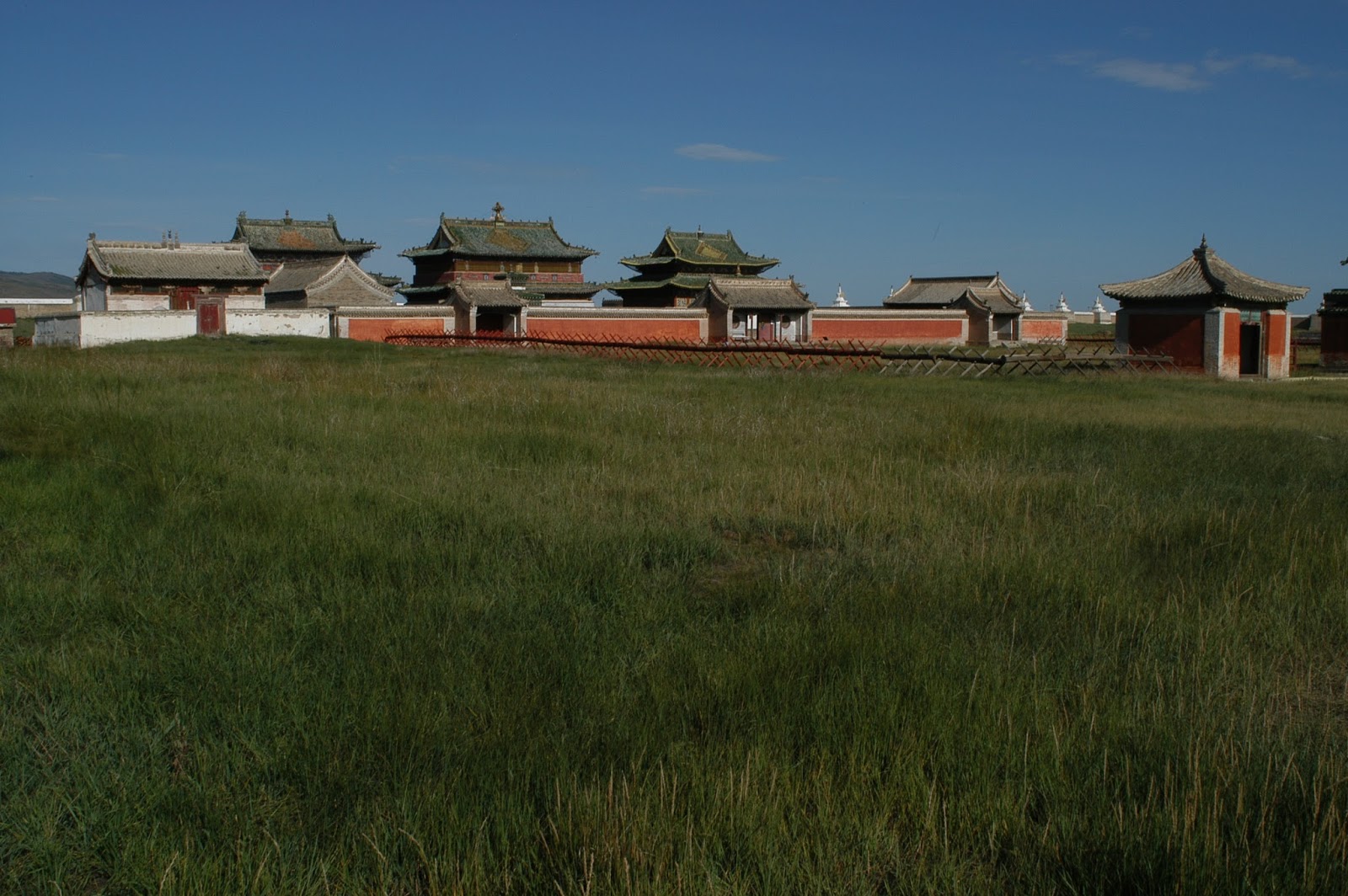
The Temples at Erdene Zuu


Due to its favorable weather, the proximity of the Orhan River which runs all year, and abundant grazing lands, it has been a significant site of many cultures beginning about 200 BC.  We stayed in a ger camp there for two nights, as there were several places to visit: Erdene Zuu, a Buddhist temple complex from the 1600’s and an old Turkic site, Shankh Hiid Monastery, from before that time. 
The Monastery at Erdene Zuu
Erdene Zuu was particularly magical. 

Part of the wall surrounding the
Temple Complex
The Gates of Erdene Zuu
Situated near the  old capital of KharaKhorum, I could imagine this complex in the 12th Century, surrounded by a wall containing 108 stupas, rising up suddenly after seeing just endless steppe.  It contained a monastery and several temples from various periods and of different styles; one large temple is still very active and we were fortunate to witness another puja, where several young monks were particularly enthusiastic and vocal, and chanting from memory!


Back at the ger camp, we were treated to another performance on the horse head fiddle, the most highly-revered traditional Mongolian instrument, as a small local group stopped by with native instruments and costumes, and shared some traditional Mongolian music. This visit followed on a meeting in UB with the lead player of the Mongolia Folk Orchestra where we got a very close visit with a horse fiddle.  A fretless two stringed cello like instrument that is bowed like a cello but fretted with knuckles beneath the string.  Quite a challenging instrument to play given the sounds it produces -- conjuring the music of the horses running across the sea of grass.

The Horse Fiddle Master
We also spent a couple of relaxed afternoons on the ger camp restaurant porch writing our even longer journals, with the camp dog at our feet, who took a shine
the Generalissimo
to us because we paid attention to her.  She, like many of her compatriots, was the camp general, who kept other dogs and wild animals out of the camp – it was hard to say goodbye to her!
The Ger along the River Orhon at dawn

Hanging out with some wild Mongolian horses (Ricky)


A night in UB, and we drove outside of the city after a lovely visit to the Gandan Monastery (Chris has expounded on that) and landed in the Hustain National Reserve, home to the rare, totally wild Przewalski’s Horse.  They say that this is the only remaining wild horse that still roams free, and their domain is beautiful, hilly, green steppe about 2 hours west of the capital. 
A traditional Nomadic Ger
We settled into our first deluxe ger, so-called because it had its own toilet and shower – the shower didn’t work, but the toilet was very welcome.  Then we set out on a fairly rigorous hike up the hill behind the ger camp.  There we discovered our first ovoo,
ovoo
a small hill of rocks intertwined with scarves in blue, white, yellow, red and/or green, each expressing a different emotion based on color.  These are considered places to meet and to show spiritual devotion, with scarves, by adding rocks or other meaningful items.  The tradition is to walk around these mounds clockwise three times, as the sun moves over the earth, and as one would around a Buddhist prayer wheel – promotes good karma. 

We climbed up for a bit, reached the top, enjoyed a lovely 360 view and then hiked down.  On the way, we spotted round, ivory-colored, soccer-ball sized mushrooms – they looked, well, alien.
Later that afternoon, as the sun was beginning to set, we drove further into the park to spot some horses.  They are extremely elusive, but we observed several small herds from a distance as they slowly made their way to a water hole.  I was glad that I had a long lens on the camera, but just made out a few individuals, their golden coats and jet black manes glowing in the setting sun.
The Wild Mongolian Horse of Hustain National Park

“UB” – from Chris


We book- marked our Mongolian trip in Ulan Bator, capital of Mongolia. Like other emerging Asian cities (see Phnom Penh down in August), I was prepared for a rough place – particularly since Mongolia is thriving off China’s hunger for coal, oil, and minerals of all kinds as they prepare to bring the next 600m people out of poverty.  1.8m in a city built to handle just 600,000. (thats more than half of Mongolia’s overall population of 2.9m)  Massive inversions in the winter locks in the black pulsing from the coal fired electric and steam plants – that are now right in the city given its expansion.
Hotel Ulaanbaator
 When not mining, the boys are pickpocketing or drinking.  “UB” was indeed thuggish on first view – clogged with traffic, officially a Left Hand Drive country but with equal number of cars using LH and RH (“it’s a cause of most of our fatal accidents”).  Pedestrians and drivers use traffic lights as mere guidance, a really young city with lots of stylish women (3 woman to 1 male in the city), drunken businessman, and punkish twenty-something boys.  Data plans have arrived and everyone’s heads are down into their phones like in other Asia cities.  We holed up in the Ulaanbaatar Hotel, a relic of the Soviet domination in the 20th century, cleaned up, but still with more promise than execution.

The temple with the puja
But the city became softer in the morning.  A visit to the Gandan Monastery, with many older Nomads in
Gandan Temple
traditional Mongolian wear, children and pigeons, older monks – a bit plumper for all their years in this harsh clime, but experienced. These older lamas are teaching the younger ones Mongolia’s unique blend of Buddhism and Shamanist practices.    We walked into a puja – the rhythmic chanting of Buddhist text in the original Tibetan – and we were welcomed.  Now, we experienced many puja’s before, but this one was intimate; we heard the breath of the lamas and smelled the dust on the ancient texts. We were both very moved – Ricky was in tears.
 
UB also saw the great resorting of stuff, cleaning clothes from our 700 mile road journey around central Mongolia and the cleaning increasing numbers of body folds from eating and drinking plenty of terrific nomadic and Mongolian fare. We are here on their first hard freeze of the coming winter (“everything is about preparing for winter”); summers like Denver (high 90’s F), winters like Gunnison (average January is -20F).  A continental climate they call it.  And the place looks like it would look better in the cold and snow.
Indeed, UB is a great walking emerging city; plenty of European style bistros, Asian hawkers, and American Imports; Coca Cola and BD’s Mongolian Grill (There’s nothing Mongolian about it). We walked and walked – and helped shore up the locally plunging Mongolian tungret with stuff only available here (wait till you see our yak sweaters).
Genghis on the left
There are remnants of domination everywhere, Stalinists in the 20th  Century, Chinese and Manchurians for the seven centuries before that. Then there was Genghis Khan.  He conquered the world from Siberia to Hong Kong and from Beijing all the way to Austria in the 13th Century.  And, Y chromosomes tells us that  1 in 200 males today may trace their lineage to Genghis and his sons. 
a young Mongolian couple
 
Beautiful people; men yes, but beautiful women.  I was told about the beautiful Mongolian woman beforehand from colleagues in Singapore to Shanghai, from Tokyo to Beijing.  I really can’t say what it is but there is something that rings true in the young women and men.  Maybe it’s a life on mare’s milk, and meat with all that calcium and protein, maybe sun and wind exposure with no south asia obsession with white skin, maybe the tall frames, the high cheekbones, long black hair and a thin muscular fitness from being raised on horses.  Every woman in stretch jeans doesn’t help dispel the mythology on the Mongolians.  
And the smell of Ulan Bator.  The winds the blow up the dust, the moisture that is captured by the surrounding mountains that cools but never hits the ground, the wind blowing in fresh air from Siberia, the dust of a city under construction, and the smells of the ever present  barbeque of beef, yak, camel, house, mutton and lamb.  Combine that with the light that hits at 47 degrees north latitude. Shared with Seattle, Quebec City, Salzburg.  It’s a defining light at this latitude that brings a higher contrast, a higher definition. A languid dawn and a lingering dusk - to the mountains all around us and to the city and to its people.

Ricky and I will miss these Asian cities. We are comfortable in these places we have never been, moving seamlessly and effortlessly through their lifestyle, their culture, their residents and their history.   

Wednesday, September 4, 2013

The Trans Mongolian Railway - Beijing to Ulan Bator


Tuesday September 3, we were on the train to Ulan Bator (UB), leaving from Beijing by 8:05am, on the dot.  After 45 minutes the industrial scenery north of the city gave way to small towns, rivers and gorgeous wooded gorges. We had no idea this kind of landscape was so close to the capital. 
Herbei Province Sails by
Our two days were spent sitting in our private berth with a thermos of tea, reading and watching Northern China float by – not really whiz by, as the speed of the train felt like around 45 miles per hour – and that was fine.  We had our own sink and shower and the shared bathroom was down the hall – it’s good that it was close by, due to the mass quantities of tea.  We supplied the tea bags, and the piping hot water was provided by a samovar also down the hall, heated by coal. 
coal fired Samovar
Our research indicated that we would see segments of the Great Wall at about 280 kilometers from Beijing, and there it was to the East, more run-down than the sections near the capital accessible to tourists, but impressive, nonetheless.  Just above the wall we could see considerable strip-mining.  Kind of symbolic of China:  fascinating history and rampant industrialization.
Yesterday, we woke up on the train, our first morning in Mongolia.  From the upper bunk, I opened the window shade and looked out on the endless
A nomadic rancher running
alongside the train
Mongolian steppe, a sage sea grassland stretching to the horizon – a very calming sight after experiencing the hordes in Beijing and overnight interruptions from the customs and immigration teams.  Late in the evening, we waited 3 hours for the train’s wheel adjustments.  Chinese trains use a standard railroad gauge of wheels; Mongolia and Russia do not – so the rail cars were moved into a shed, raised up on big, red hydraulic lifts, the Chinese wheel carriages were removed, and the Mongolian carriages were installed.  Lots of clanging and jerking around – Chris left to scrounge around the station; I stayed on board – interesting experience.
swapping the bogie
  Then at 12:30, Chinese officials took our departure documents, made sure we looked like our passport pictures (“smile, please”), at 1:00am Mongolian officials showed up for immigration and we were on our way. Note; a global standard – immigrations officials everywhere are humorless, dehumanizing lost souls.

also as part of this swap, we swapped our Chinese dining car for a Mongolian dining car.  A great Mongolian menu!  we ordered up some interesting looking dishes for breakfast - the new Mongolian waiter, in true Khan family fashion, nodded yes politely and then barked "NO!  just Omelette, toast, coffee! $15 USD!".  That offerring was not on the menu.  We were in the land of Genghis Khan.

This morning we leave for our Mongolian journey, starting with a look at the Ganden Monastery in UB.  Then to the Steppe!  In the “outback” of Mongolia, there is no Internet, so you won’t hear from us until we are back in UB.